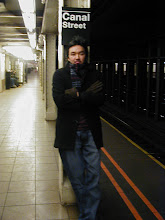
Last night I met my intellectual mentor… William Liddle (Pak Bill) in Metro TV. He was in the office to appear on the “Save Our Nation” program to talk about Soeharto (since his latest deteriorating health condition, rumor has it that the Indonesian dictator for 32 years won’t make it this time). There was a sense of joy and nostalgia talking to him after three years since I left Columbus in 2004. He’s still the same old “Pak Bill” with his signature self-effacing demeanor, always cautious in making any optimistic comments about the country’s progress so far. Behind the humble exterior, lies a deep analytical mind that might enlighten anybody’s inquiries about Indonesia, since he’s been following this country’s political and economic development for more than 40 years. He taught me an important lesson that an “intellectual” is not someone who can daze others with his/her ability to talk in esoteric and abstract language, but it’s about being able to explain complex phenomenon in simple language, the ability to convey your ideas and message in the language understood by common people. It’s a failing that I’ve seen has trapped a lot of Indonesian intellectuals when they talked or write in the mass media (either in Metro TV or Kompas).
Anyway, I am very proud to declare myself as one of his “intellectual offspring” among countless other Indonesians he has taught throughout his long tenure in Ohio State University. It’s not so much that I shared all his ideas and analysis on Indonesia, in fact, he always emphasized independent thinking to his students. He always said that he never tried to impose any kind of interpretation or ideology to his students, even though people wouldn’t be mistaken that he is “right-of-center” type of observer (contrast with Daniel Lev, an equally astute left-leaning “Indonesianis “), he only provides the information and the context of historical events in the country in order for us to formulate our own interpretation toward the event. But I do share his view on Soeharto that his rule has laid the groundwork of economic development inside the country toward stable growth (Liddle provides sample of other countries who embark on the same journey around the same period as the New Order military dictatorship like Myanmar/Burma which is still a basketcase in economic growth story in the world). On the political front, his rule is pure “authoritarian” which didn’t tolerate any opposition or dissent. For me personally, he has completely shut out the political aspiration of Indonesians, resulted on what political scientists described as “floating mass” or “massa mengambang,” a terminology to describe faceless voters who are only mobilized during the quasi-campaign season every 5 years. One comment struck me during our conversation last night when I asked Pak Bill whether Indonesians really need that certainty regarding the legal status of Soeharto, whose criminal case has been closed due to illness thus was never put on trial, he answered: “Did Soekarno?”
It’s a question that I think Indonesians have to grapple and settle with once and for all in order to establish a precedent of strong rule of law inside the country. Besides, it concerns the legacy and image of our country’s founding father and long-time ruler. At the end of the day, the question boils down to what will we tell and teach in our history textbook to our children and grandchildren in the future about these two larger-than-life figure in Indonesian history?
Confusing? Indeed…
Ps: latest article from NYT which brilliantly captured the current landscape of Indonesian politics and society (more or less in tune with my observation so far of Indonesia) - http://www.nytimes.com/2008/01/12/world/asia/12indo.html?ref=world
Tampilkan postingan dengan label Politics. Tampilkan semua postingan
Tampilkan postingan dengan label Politics. Tampilkan semua postingan
Kamis, 10 Januari 2008

Senin, 07 Januari 2008
Putin

Before I write something about this man, below are links that will be worth your time to read in order to understand the nature of influence he brought to Russia and its post-communist society. Especially check out the second article from the Economist magazine. It's much better than John Le Carre's spy fictional novel... only this story happens in reality.
Minggu, 06 Januari 2008
Obama - politics at its finest
I want to talk about politics... The 3-syllable word has been so denigrated lately that when you say you want to become a politician, people would frown upon you or giving you that bedazzled look, as if you were saying that you want to become a burglar.
But, let me single out three most notable politicians on the world stage at the moment, and we might understand the nature of politics and power associated to it: Obama, Putin, and Sarkozy.
Those three individuals have proven that politics is a noble profession, and if exercised wisely and judiciously, its power can change the whole structure and outlook of society. It is why I’m always personally drawn to the allure of political world.
 Barack Hussein Obama, the US Democratic presidential candidate has truly shaken up the political system in United States, with its Hope.Inc brand of politics and political charisma unseen since the day of JFK. The enthusiasm and movement he has generated felt genuine for me this time. And he recently won the first Democratic caucus in Iowa (with 38% against his rival John Edwards – 30% and the establishment candidate, Hillary Clinton – 29%) The result is set against the backdrop of Iowa being a rural state with more than 90% white population. It says something about American society nowadays who seems ready to move beyond racial politics. Obama himself since the beginning has portrayed his candidacy as post-racial politics. The momentum he gained in Iowa will help him a lot to trailblazing through other states. Many critics have predicted that his candidacy would face similar fate like Howard Dean’s campaign on 2004. Well, it did share some similar characteristics (the aura of insurgency, anti-establishment, and dominated by young voters) but if you look beyond those traits, I’m sure you will agree with me that his identity, personal stories, and vision for society as captured by his autobiography and political manifesto, Dreams from My Father and The Audacity of Hope, have truly sank into the voters’ conscience. And don't forget that American people has suffered too much partisan politics during the Bush years, and they are so ready to "move on" or "turning the page" of that era. In the end, Obama has gained that elusive and subtle trait that other politicians would die for to cloak themselves in: authenticity.
For some reason, I’ve got to make a confession (which I think might draw a lot of cynicism and skepticism for people who read this) It goes something like this: reading Obama’s autobiography, Dreams from My Father, and also historical biography of Abraham Lincoln brilliantly captured by the writing of respected American historian, Doris Kearns Goodwin, in her book called Team of Rivals-Political Genius of Abraham Lincoln, I can’t help but feeling that I personally share both men’s characteristics and predicament which suited them to plunge themselves into politics. One word: empathy. If there were one trait that connects those characters, it would be emphatic skill, which can go a long way when you become a politician. Empathy, defined simply, as being able to feel what others are feeling, or being able to put yourselves in others’ shoes. Obama embodied that trait since his identity as the offspring of mixed-race marriage suited him perfectly, add to that his experience of living in Indonesia, travelling to his ancestral hometown in Kenya, and his long years of working as community organizer surely has honed that empathic skill tremendously. You can’t fake empathy when you see and feel it in other’s eyes and touch, and to a certain extent, either you were born with it or you don’t. Lincoln’s empathic skill has served him well in leading the North to defeat the South (thus ending the slavery in the US) not with sheer brutal military forces, but also with sophisticated power of persuasion, rhetorical as well as political skill. He seems to have that unique temperament and brilliant mind to be able to sense his country’s mood and at the same time shaping it to his will.
Also, the main thing I can relate to Obama’s life story is on the subject of his struggle to make peace with himself about who he is and where he came from. (Being a member of minority groups, African American, and not quite comfortable and accepted by its community) In my personal case, I also have struggled with my identity as member of minority groups (Chinese-Indonesian) and have to make peace with myself on the identity I was born with. I still remembered vividly those period where I have a contempt and dissatisfaction toward my own cultural group, how I always try to become as Indonesian as possible (e.g. like refusing to talk with my parents in Mandarin, a language which have been taught to me since I was little, and also developing some kind of self-defense mechanism of always talking in racial terms with my friend to accentuate my “Chinese-ness”, etc) But, in the end, I think I’ve gained the maturity to accept and be proud of who I am and where I came from. There is not one moment where it happened, but somehow it just arrived and I’m changed ever since.
Well, talking about Obama deserved more than a simple observation like this… but for now, this writing will do as we moved on to our next character in global politics… Vladimir Vladimirovich Putin.
Langganan:
Postingan (Atom)